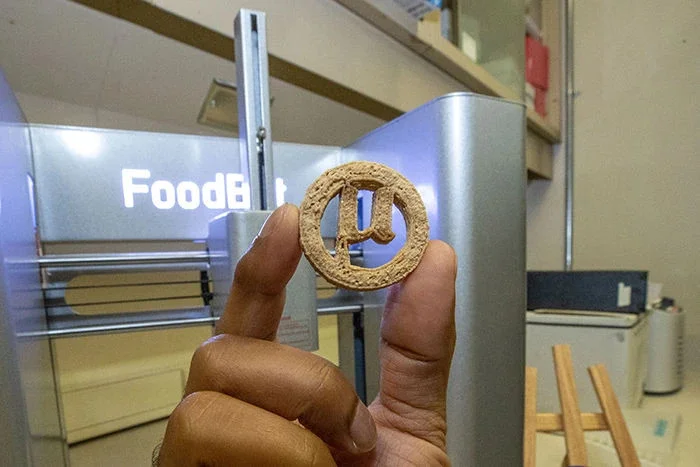
The notable part of µBites isn’t that plastic ends up in a cookie. It’s that engineered yeast can turn plastic and agricultural waste into edible proteins and flavor compounds, giving waste a possible role in food production. That distinction matters: the concept depends on microbes transforming waste into ingredients, not on serving plastic in a new form. It’s a research project about what those conversion steps might make possible, not evidence that waste-derived foods are ready for grocery shelves.
Led by Lahiru Jayakody, an associate professor, the project was presented at an American Chemical Society symposium at Chicago’s McCormick Place in August. The team developed the 3D-printed cookies for NASA’s Deep Space Food Challenge, placing the work in the context of food production for space rather than near-term retail. A challenge focused on space food gives the project a demanding design brief: food has to be produced from available resources, and it has to provide ingredients people can eat. The presentation establishes the work’s setting; it doesn’t, by itself, show how the cookies would perform as a complete food supply.
The researchers call the cookies “µBites,” pronounced “microbites.” The name draws on µ, the Greek letter used for the metric prefix micro, meaning one-millionth. It’s a small branding detail, but the underlying idea is easier to grasp when the product’s name doesn’t obscure the science: microbes are meant to do the conversion work, while the cookie is a way to present some of the resulting ingredients.
Microbes do the conversion
Plastic isn’t mixed directly into the dough. Instead, microbes process waste feedstocks into ingredients. The approach resembles familiar fermentation used to make yogurt, kombucha, beer, and wine, but starts with waste rather than conventional food ingredients. That comparison helps explain the basic mechanism, though it shouldn’t flatten the difference: fermentation for familiar foods starts with materials already used in food production, while this project asks whether microbes can make useful food components from waste streams.
That change in starting material is where both the appeal and the unanswered questions sit. A waste feedstock has to be converted into something useful and suitable for food, and the resulting ingredient has to fit into a recipe in a meaningful way. The article’s account describes the intended process, but gives no detail about how much feedstock is needed, what share becomes edible material, or how the ingredients are assessed. Those are the kinds of practical questions that determine whether an intriguing lab concept can scale.
The team also engineered yeast to make compounds that affect taste, smell, and color. These include vanillin, associated with vanilla’s flavor and aroma, and beta-carotene, a precursor to vitamin A. Flavor and appearance aren’t decorative concerns in a food system; they shape whether people would want to eat the result. But the presence of these compounds doesn’t tell us how the cookies taste, what their nutritional profile is, or whether the ingredients can be produced consistently. The project has identified functions the yeast can serve, while the larger food product still needs to prove itself.
Why space food is a useful test
For astronauts, µBites could become another potential food source. On Earth, the same research points to a way to convert plastic and agricultural waste into protein-rich ingredients, with possible relevance to food shortages. Those are two related but distinct ambitions. Space missions put a premium on making food from limited resources, while Earth’s food systems would need to contend with the practical requirements of producing, distributing, and accepting new ingredients.
Space is a demanding context for food research because a proposed food source has to do more than sound sustainable. It has to provide something people can eat and contribute to a workable food supply. In that sense, the challenge can focus attention on resource use and ingredient production. It can’t establish that the same process will be economical or appropriate for broad use on Earth. Here’s the thing: a solution to one setting’s constraints doesn’t automatically transfer to another.
This is more significant than it looks as a research direction. Food production often relies on materials already considered food inputs; µBites asks whether some waste can become a starting point for producing food ingredients. If you're working in this space, the key question isn’t just whether microbes can make a protein or flavor compound. It’s whether they can do so as part of a process that yields useful ingredients reliably, with qualities that make sense in a real diet.
What the next steps need to show
Jayakody’s team plans to refine the cookies by having microbes produce more ingredients, including starch, fiber, and sweeteners. The next step will show whether the process can broaden its ingredient range—and how far waste-based microbial food production can go toward meeting rising food demand. Those additions could give the researchers more of the building blocks needed to make a cookie, but a longer ingredient list won’t answer every question. The process will also have to show that the ingredients work together in a product people would actually choose to eat.
A broader range of ingredients could make the concept more useful, since protein alone doesn’t make a balanced or appealing food. Starch, fiber, and sweeteners each play different roles in a recipe, and their production could change what the team can make. Yet the source doesn’t report how much of any ingredient the yeast produces or how close the cookies are to meeting nutritional needs. For now, µBites is best read as a demonstration of a possible route from waste to food components, with the cookie serving as an early expression of that route.
And yet, turning waste into food ingredients would only be one part of a much larger system. The feedstocks would need to be suitable for the process, the microbial conversion would need to produce food-grade ingredients, and the resulting product would need to meet practical expectations for taste and nutrition. (And this is the part most people overlook.) A clever conversion step doesn’t settle those questions; it makes them possible to ask.
There’s a long way between a research cookie and a dependable food source. Still, the project points to a clear next test: can the team expand what its microbes produce and make those outputs useful in a finished food? If it can, µBites may offer a model for treating some waste as a resource. For now, the promise is real enough to investigate, but the evidence described so far supports a research prospect, not a claim that plastic waste is about to feed astronauts or solve food shortages.
Discussion
Sign in to join the discussion.