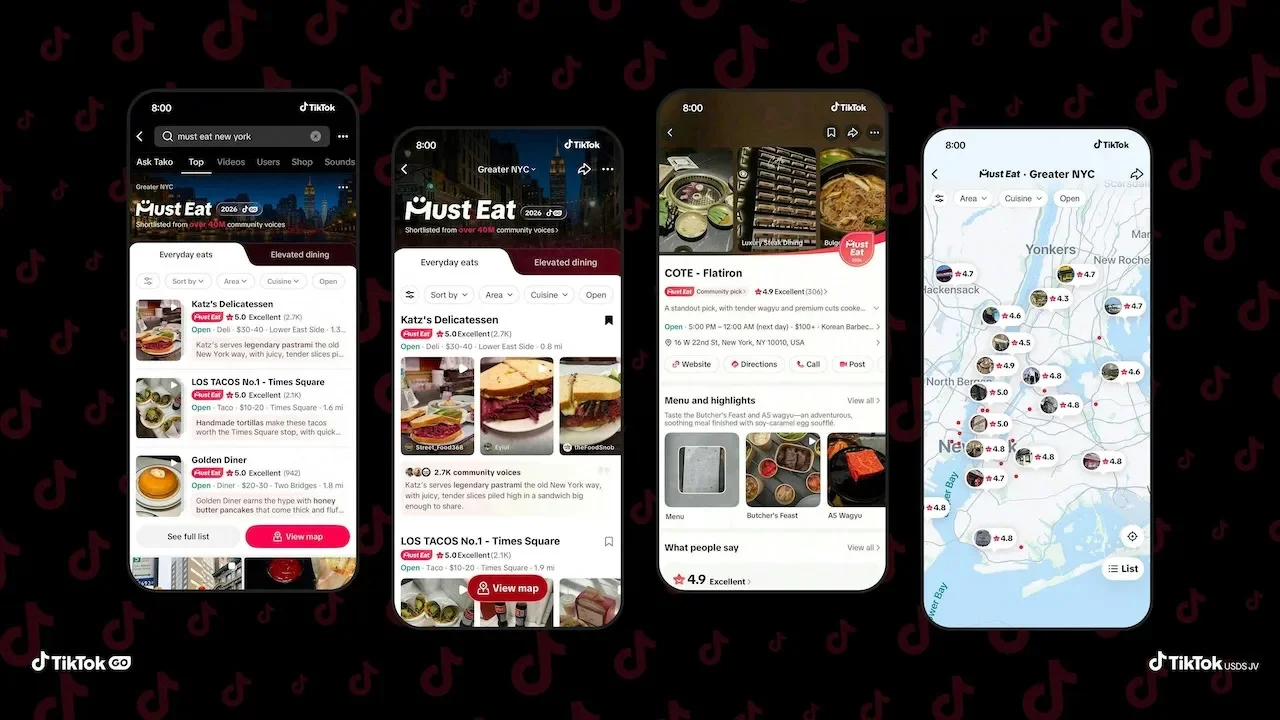
A food feed becomes a restaurant guide
TikTok is turning food discovery into a more structured service with Must Eat, a restaurant guide built from more than 40 million posts, reviews and comments. It starts in New York City, Los Angeles and the San Francisco Bay Area, where users can browse casual spots under Everyday Eats or occasion-focused restaurants in Elevated Dining. The categories give people a quicker way to narrow a broad set of recommendations by the kind of meal they have in mind.
That organization addresses a familiar weakness in social media recommendations: a video can make a restaurant look appealing without answering basic questions about whether it suits a quick lunch, a special occasion or a particular neighborhood. A guide can put more of that discovery in one place. But the volume of material behind Must Eat doesn't, by itself, tell users how the recommendations are ranked or how much weight each post, review or comment carries.
Community discovery, with a popularity problem
The guide draws on TikTok’s food community, giving independent restaurants and local specialties priority. Businesses can’t pay for placement, and TikTok checks each one before it appears to confirm it’s open and in good standing. Those steps give the guide a community-driven premise and address two practical concerns: paid visibility and outdated listings.
Still, a check that a restaurant is open doesn't establish that it will suit every diner, or that its online attention reflects a consistent experience. TikTok content is shaped by what people choose to film and share, which can favor visually distinctive dishes and places that already draw attention. Here's the thing: a popular recommendation can be useful, but repeated exposure can also make a guide feel less like a map of local options and more like a queue for the same handful of tables.
TikTok says 27 million Americans have tried an independent restaurant, café or shop for the first time after finding it on the platform, contributing an estimated $4.7 billion in local spending. Those figures frame the platform as a meaningful discovery channel, though they don't show how Must Eat itself will affect visits or spending. The guide puts existing behavior into a dedicated product; it doesn't yet demonstrate that the format will improve the quality or breadth of recommendations.
From finding a place to booking it
The feature also connects with TikTok GO, the platform’s service for discovering and booking experiences. An OpenTable integration lets users reserve a table at participating restaurants without leaving TikTok. That shortens the path from watching a food video to making a plan, which may be convenient for users who already rely on the app for recommendations.
The connection also gives TikTok a larger role in the dining decision. Discovery, evaluation and booking can happen in the same service, reducing the need to switch between apps. If you're working in this space, that integration is the part to watch: a recommendation becomes more consequential when it leads directly to a reservation.
What will make Must Eat useful
Must Eat is available through search, the Local Feed, restaurant location pages and location tags on videos. Those entry points make the guide accessible from several parts of TikTok, rather than requiring users to know the feature’s name before they start looking. For a product built from a large stream of community content, discoverability matters; users need a clear route from a local query to options they can compare.
The harder question is whether the guide can help users find restaurants beyond the ones already circulating widely on the platform. More than 40 million posts, reviews and comments provide a large pool of material, but size isn't the same as balance. A useful guide needs to turn that material into choices that reflect different occasions and local tastes, while helping businesses absorb attention they can actually serve (and this is the part most people overlook).
This is more significant than it looks: TikTok is making food discovery part of its broader path from content to action. Must Eat’s value will depend on whether it can turn TikTok’s vast stream of food content into useful local recommendations without sending every user to the same newly viral table. If it can’t, the guide may make finding a popular restaurant easier while leaving the harder work of finding the right one to the diner. A promising start, with the real test still ahead.
Discussion
Sign in to join the discussion.