A personal pizza, packaged as a game promotion
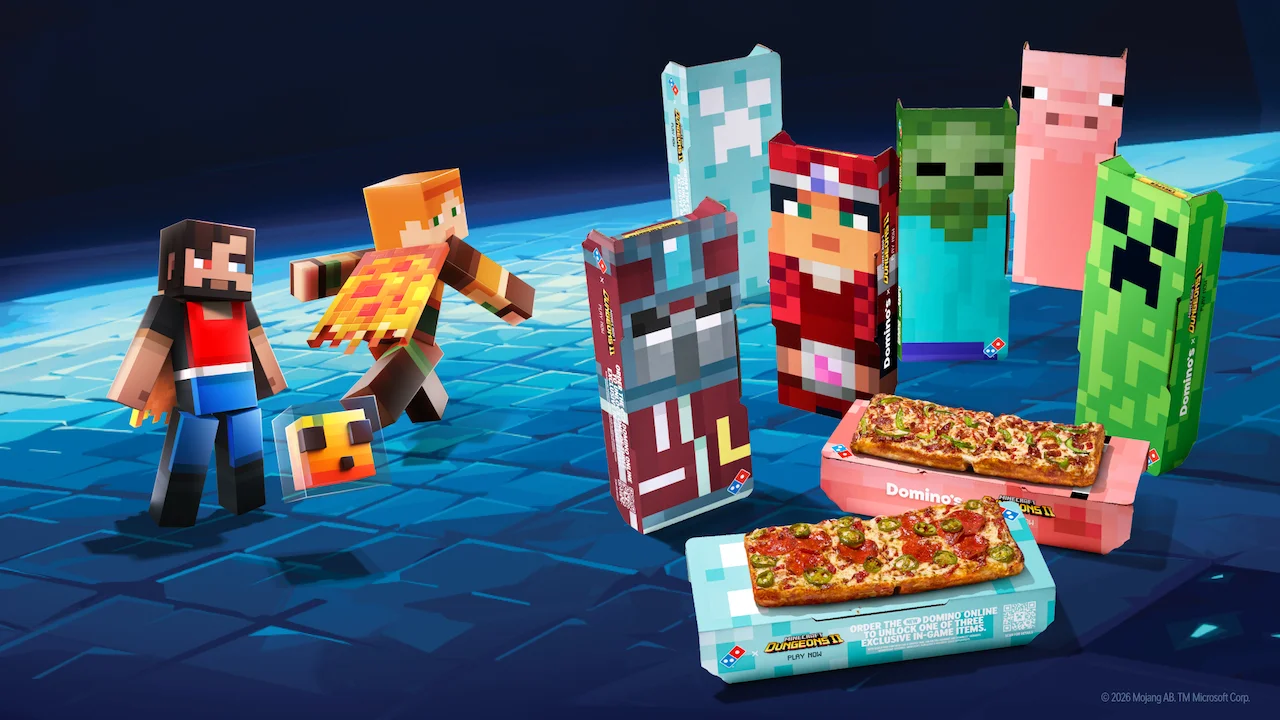
Domino’s is tying its new personal pizza to the upcoming release of Minecraft Dungeons II, with a promotion that combines game giveaways, digital extras and collectible packaging. The campaign starts October 26 and centers on the Domino, a pizza designed for one and cut into two rectangular blocks. The shape gives the product a visual connection to Minecraft’s familiar blocks, while the game tie-in gives the launch a hook beyond portion size. That’s a compact bit of product marketing: the food, the packaging and the digital offer all point toward the same audience.
The promotion also illustrates how fast-food brands can turn a limited-time product into a broader participation campaign. A customer isn’t only choosing a pizza; they’re being invited to claim a game code, collect a digital item or look for a particular box design. Each part serves a different purpose. The giveaway is the most direct value, the in-game rewards add a smaller layer of personalization, and the packaging can make an ordinary takeout order feel like part of the campaign.
That combination is familiar in branded promotions, where a purchase provides the entry point and digital rewards give customers a reason to engage after the meal. But the mechanics matter. A promotion can sound generous in an announcement and still require customers to follow several steps before they see the benefit. Here, the game giveaway requires proof of purchase and entry through the official page, while the digital items are linked to online orders by Domino’s Rewards members.
How the game giveaway works
The main draw is 20,000 digital copies of Minecraft Dungeons II, distributed at 2,000 per day from October 26 through November 4. Each copy is valued at $29.99. Customers can enter by buying a Domino and submitting proof of purchase through the official promotion page; the codes are valid only on PC and Xbox.
The daily distribution makes timing part of the offer. Customers aren’t simply buying the pizza and receiving a copy automatically; they need to submit proof of purchase, and the available codes are divided across the campaign period. That distinction is easy to miss when a headline emphasizes the total number of free games. The total gives the promotion scale, while the daily allotment and entry process determine what a customer actually has to do.
The platform restriction also narrows the audience. A code that works on PC and Xbox won’t serve someone who plays elsewhere, so the stated value of the giveaway depends on whether the recipient uses a supported platform. That’s common with digital rewards: they can be inexpensive to distribute compared with physical merchandise, but they’re only useful when they fit the customer’s hardware, account and preferences.
There’s a practical trade-off here. A digital game is a more substantial prize than a themed box or a cosmetic item, yet it asks customers to act within a defined window and check the terms that apply to their platform. If you’re considering the offer, the promotion page is where the entry details and eligibility conditions should be checked before ordering. The headline number alone doesn’t explain the full path from purchase to code.
Digital items and collectible boxes
Domino’s Rewards members who order a Domino online can also receive one of three randomly assigned in-game items: a Domino’s character skin, a Slice Slayer Cape or a Cheesy Cube Pet. The pet follows players but doesn’t assist in combat, a fittingly low-stakes detail for a promotion built around pizza and block-shaped game worlds. These are cosmetic or companion rewards, rather than additions that promise an advantage in play.
Random assignment changes the character of the reward. Customers know which three items are possible, but the source doesn’t say they can choose among them. That uncertainty can make the offer feel like a collectible, though it can also mean a customer gets an item they’re less interested in. The distinction is small, but it’s part of how these promotions work: the brand can offer variety without promising every customer a specific digital object.
Six character designs will appear on collectible boxes while supplies last: Creeper, Zombie, Pig, Valorie, Corrupted Creeper and Prime Enchanter. The boxes add a physical layer to a campaign otherwise centered on codes and digital content. They may appeal to fans who enjoy seeing game imagery on familiar products, but “while supplies last” means availability can vary. A named design isn’t a guarantee that a particular box will be available with every order.
Domino’s also says an interactive, Minecraft-themed pizza tracker is planned for a later date. That feature could extend the campaign into the waiting period between ordering and delivery, when customers already have a reason to check an app or website. The tracker’s details aren’t provided, so its eventual appeal will depend on what it actually lets customers see or do. A themed interface can add personality, but the novelty has to survive repeated use.
Why the format matters
Here’s the thing: the promotion is less about any one reward than about connecting several ordinary parts of a restaurant order. The pizza gives the campaign a product to sell, the game code offers a headline prize, and the skin, cape, pet, boxes and tracker create smaller points of contact. That structure gives the promotion several ways to reach customers, from players who want the game to fans who simply like the packaging.
And this is the part most people overlook: a tie-in can be memorable without changing the product itself. The Domino remains a personal pizza cut into two rectangular blocks. The Minecraft connection changes how the product is presented and what customers may get alongside it. That can make a limited-time item more noticeable, though it doesn’t tell us whether customers will like the food or return for it once the promotion ends.
This is more significant than it looks as a marketing exercise, but the offer shouldn’t be mistaken for proof of lasting demand. Branded promotions can attract attention because they combine a familiar purchase with entertainment people already follow. Their success depends on execution: clear terms, accessible rewards and a product customers actually want. If any one of those pieces falls short, the campaign’s many extras may not make up the difference.
What customers should watch
For customers, the useful questions are straightforward: Does the game code work on your platform? Are you willing to submit proof of purchase through the promotion page? Do you need to be a Domino’s Rewards member and order online to receive one of the in-game items? The source describes different requirements for the game giveaway and the digital items, so treating them as one automatic bundle could lead to confusion.
There’s also a difference between a guaranteed purchase feature and a limited or randomized reward. The pizza is the product at the center of the offer; the game codes are distributed in daily quantities, the digital items are randomly assigned, and the collectible boxes are available while supplies last. Those distinctions are ordinary promotion mechanics, but they shape what a customer can reasonably expect.
The campaign has plenty of moving parts, and that’s both its appeal and its test. A game giveaway can bring attention; collectible packaging can make the order feel distinctive; digital extras can keep the tie-in present after dinner. Whether the combination feels worthwhile will depend on the customer’s platform, interest in the game and patience with the entry steps. For everyone else, it’s a personal pizza with an unusually elaborate set of extras.
Discussion
Sign in to join the discussion.